
Preventive Ant Treatments
Professional ant prevention services in bd offering barrier treatments, exclusion sealing & year-round protection. Residential & commercial ant proofing in Dhaka.
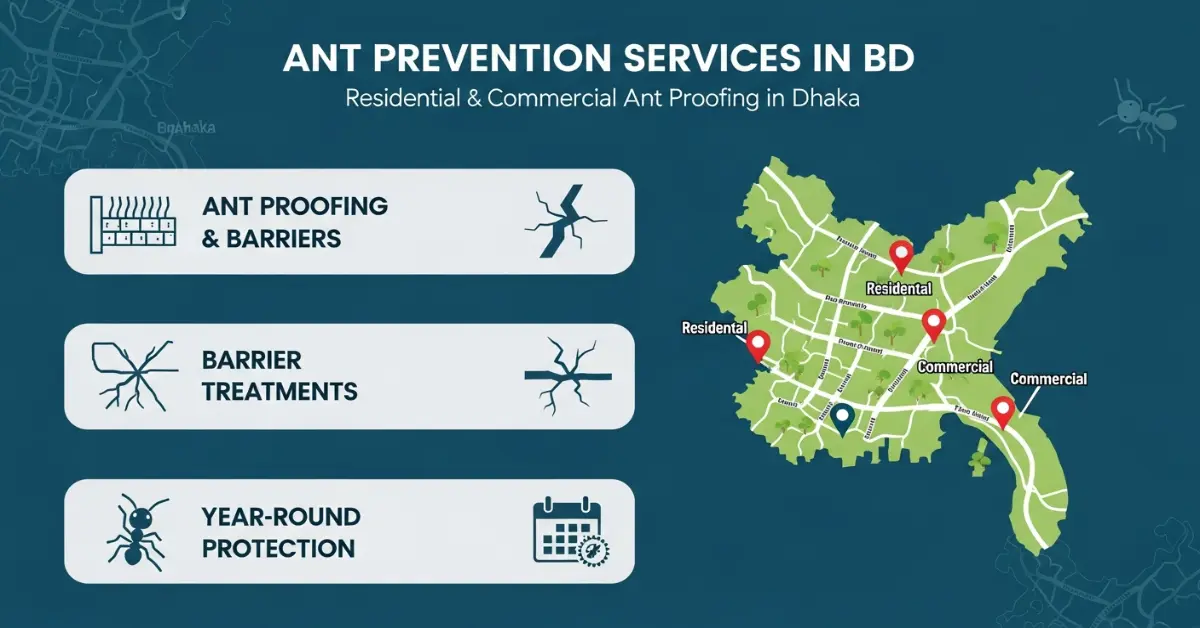
Preventive ant control Bangladesh
Ant infestations in Bangladesh have reached unprecedented levels, with over 54% of pest control professionals reporting alarming increases in colony establishment across residential and commercial properties. The country's tropical monsoon climate—characterized by 80% average humidity, temperatures between 25-35°C, and distinct wet seasons—creates perfect breeding conditions for ants year-round, making reactive treatments insufficient for long-term protection. This reality has driven exponential growth in demand for professional ant prevention services that stop infestations before they start, rather than merely addressing visible symptoms after colonies establish themselves within walls, foundations, and structural voids.
Year-round ant protection Bangladesh
Professional ant prevention services represent a paradigm shift from traditional extermination approaches, focusing instead on integrated exclusion techniques, barrier treatments, and habitat modification that render properties inhospitable to ant colonization. Leading Bangladeshi providers including Max Enterprise Uttara, Pest Control Dhaka, and SM Pest Control Services have developed comprehensive prevention programs combining physical exclusion (sealing entry points with silicone caulk and weatherstripping), chemical barriers (perimeter treatments with residual insecticides), and environmental management (moisture control, vegetation management, and sanitation protocols). These multi-layered approaches prove particularly crucial for commercial facilities—including restaurants, pharmaceutical companies, and garment factories—where ant contamination violates health codes and jeopardizes export certifications.
The Science of Professional Ant Prevention Methodologies
Modern ant prevention services operate on principles of Integrated Pest Management (IPM), emphasizing proactive exclusion over reactive extermination. The foundation of effective prevention lies in understanding ant biology—specifically that most household ants establish outdoor nests and enter structures temporarily seeking food, water, or shelter. Professional technicians conduct comprehensive property assessments identifying conducive conditions: vegetation touching building exteriors, moisture accumulation near foundations, unsealed utility penetrations, and sanitation deficiencies that attract foraging workers. By eliminating these attractants and creating physical/chemical barriers, ant prevention services achieve long-term protection without the environmental impact of broadcast spraying.
Exclusion techniques form the first line of defense in professional ant prevention services. Technicians seal cracks and crevices around windows, doors, and utility openings using silicone caulk, install door sweeps and weatherstripping to eliminate ground-level entry, and apply petroleum jelly or physical barriers to known trail routes. For commercial facilities, this includes installing insect-proof screens on ventilation systems and sealing expansion joints in concrete slabs. These physical modifications provide permanent protection that chemical treatments alone cannot match, particularly against persistent species like black garden ants and odorous house ants that readily reestablish trails after temporary repellent applications.
Barrier treatments complement exclusion by creating protective zones that intercept ants before they reach structures. Professional ant prevention services apply residual insecticides around foundation perimeters, window frames, and entry points using formulations designed to withstand Bangladesh's heavy monsoon rains. Modern micro-encapsulated products provide 3-6 months protection even in high-humidity conditions, while granular barriers in garden beds and mulch areas target outdoor nesting sites. Unlike DIY sprays that create repellency gaps, professional applications ensure continuous coverage through calibrated equipment and commercial-grade products unavailable to consumers.
Why Reactive Ant Control Fails Bangladeshi Properties
The limitations of reactive ant control have become increasingly apparent as Bangladesh's urban density intensifies and ant species diversity expands. Traditional extermination approaches—spraying visible trails or applying over-the-counter baits—address only symptomatic foragers while leaving queens and brood untouched in hidden nests. This creates "rebound" infestations within weeks, as surviving colony members accelerate reproduction to replace losses. Professional ant prevention services eliminate this cycle by preventing initial entry, making colony establishment impossible rather than merely inconvenient.
For Bangladesh's commercial sector, reactive approaches pose unacceptable business risks. Food processing facilities face product contamination recalls, restaurants risk health department closures, and export-oriented garment factories lose certifications essential for international contracts. The Export Processing Zones (EPZ) mandate documented pest prevention programs, with failed audits resulting in production halts and contract cancellations. Professional ant prevention services provide compliance documentation, service warranties, and audit-ready reporting that protects business continuity while satisfying international buyer requirements. The shift toward preventive service contracts—quarterly or annual agreements including regular inspections and maintenance treatments—reflects growing recognition that consistent, professional prevention costs substantially less than emergency remediation and business interruption.
How to Order
Follow these simple steps to book your service quickly and easily.
Select Service
From the category, select the service you are looking for.
Book Your Schedule
Select your convenient time slot that fits your availability.
Place Order
Confirm your order by clicking “Place Order”.
Comprehensive Ant Prevention Service Components
Professional ant prevention services in Bangladesh deliver multi-phase protection programs tailored to property type, construction characteristics, and local ant pressure. The process initiates with thorough inspection using moisture meters, thermal imaging, and borescope cameras to identify hidden vulnerabilities: subterranean moisture gradients attracting nest establishment, wood-soil contact points vulnerable to carpenter ants, and micro-cracks in foundations serving as entry highways. Technicians document all findings in detailed reports providing baseline conditions and specific recommendations prioritized by risk level.
Exclusion work represents the most labor-intensive component of ant prevention services, requiring skilled craftsmanship to achieve pest-proof sealing without compromising building ventilation or aesthetics. For residential properties, this includes applying silicone caulk around window frames and door casings, installing copper mesh in weep holes (resistant to ant chewing unlike steel wool), and sealing gaps around plumbing penetrations with expanding foam. Commercial facilities require additional measures: installing air curtains at loading docks, applying door sweeps on warehouse roll-up doors, and sealing roof penetrations where HVAC lines enter structures. Leading providers like Max Enterprise Uttara guarantee their exclusion work for 12 months, returning to address any seal failures at no additional cost.
Barrier treatment applications utilize commercial-grade residual insecticides including fipronil, lambda-cyhalothrin, and pyrethroid formulations selected for effectiveness against target species and environmental safety. Technicians create continuous perimeter barriers 3-6 feet wide around structures, treating soil, foundation walls, and vegetation contact points. For properties with history of fire ant problems, ant prevention services include broadcast application of growth regulator baits (methoprene, pyriproxyfen) that sterilize queens and prevent colony maturation. Indoor barrier treatments focus on baseboards, pipe chases, and kitchen areas using gel formulations or dusts in wall voids, providing protection without airborne chemical exposure.
Environmental modification consultations complete comprehensive ant prevention services, addressing habitat factors that attract ant activity. Technicians recommend vegetation management—maintaining 2-foot plant-free zones around foundations, trimming tree branches away from rooflines, and removing decaying wood or organic debris that harbors nests. Moisture control measures include repairing leaking faucets, improving drainage around foundations, and installing dehumidifiers in crawl spaces. Sanitation protocols target food attractants: proper food storage in sealed containers, immediate spill cleanup, and pet food management. These cultural practices, combined with professional treatments, create inhospitable environments that prevent ant colonization more effectively than chemical dependence alone.
Sector-Specific Ant Prevention Applications
Different property types in Bangladesh require specialized ant prevention services addressing unique operational constraints and regulatory requirements. Residential services prioritize family safety, utilizing low-toxicity botanical barriers (neem oil, pyrethrin) and physical exclusion that protects children and pets. Treatments accommodate household schedules, with technicians working during business hours while residents are away, and utilizing odorless formulations that don't disrupt home environments. Annual residential prevention contracts typically include quarterly perimeter treatments, semi-annual interior inspections, and emergency response guarantees for breakthrough activity.
Healthcare facilities including hospitals, clinics, and pharmaceutical storage require ant prevention services utilizing the most conservative treatment approaches. These environments demand zero-risk strategies emphasizing physical exclusion, environmental management, and biological controls. Chemical treatments, when necessary, use boric acid or diatomaceous earth in inaccessible voids rather than broadcast applications. Service frequencies increase to monthly or bi-weekly to ensure immediate detection of any activity that could compromise sterile environments or medication storage. Specialized training for healthcare technicians includes infection control protocols and patient safety awareness distinct from standard commercial service requirements.
Geographic Coverage and Service Accessibility Across Bangladesh
Professional ant prevention services have expanded significantly beyond Dhaka to establish nationwide coverage matching Bangladesh's industrial decentralization. In the capital and surrounding Gazipur, Narayanganj, and Savar industrial zones, providers maintain 24-hour response capabilities for commercial emergencies, with routine residential services scheduled within 48 hours. The density of high-rise apartments in Dhaka requires specialized vertical prevention strategies, treating ground-floor perimeters while addressing ant highways through utility conduits and structural voids that connect multiple units.
Rajshahi and Khulna divisions have experienced rapid ant prevention services growth as agricultural processing and pharmaceutical manufacturing expand. These services emphasize exterior perimeter protection for grain storage facilities, with prevention programs designed to protect stored commodities from ant contamination that causes rejection by international buyers. The drier climate in northwestern districts reduces moisture-related ant pressure but increases challenges from heat-tolerant species requiring specialized treatment timing.
Rural ant prevention services focus on agricultural protection, preventing ant species that tend aphids on crops or protect honeydew-producing insects that damage yields. These programs integrate with crop management practices, utilizing biological controls and selective treatments that preserve pollinator populations while protecting agricultural investments. The expansion of contract farming and export-oriented agriculture has increased demand for professional prevention that meets international phytosanitary standards.