
Termite Inspection & Treatment
Professional termite control services in Bangladesh. Expert termite treatment, pre/post construction protection & colony elimination.
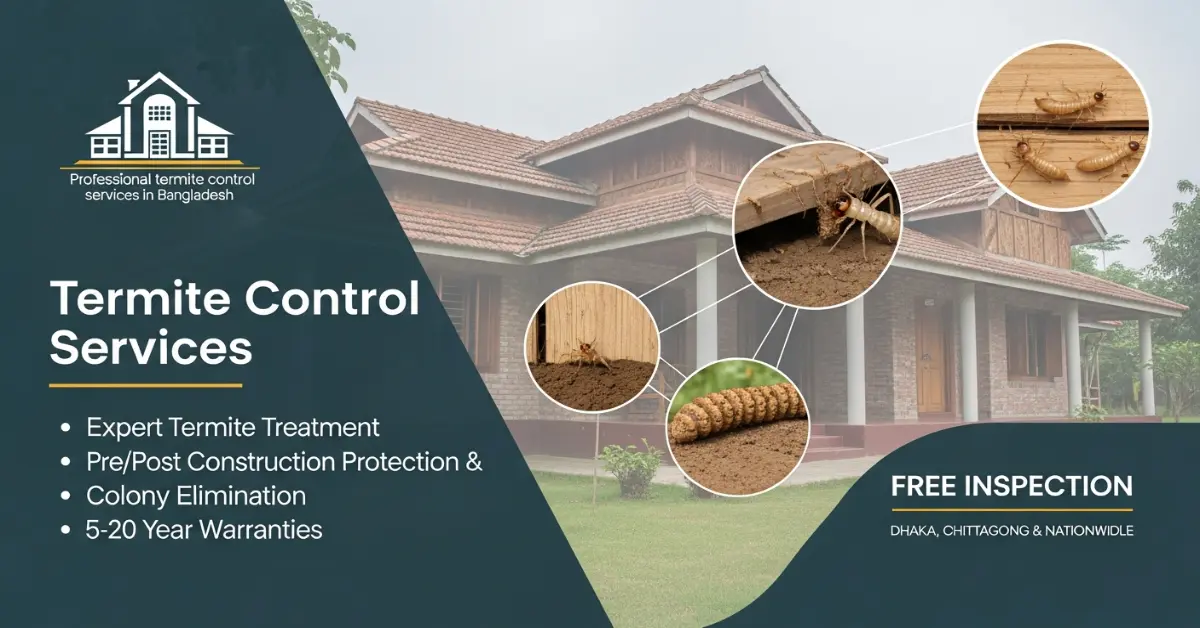
Termite control services Bangladesh
Termites represent the most economically destructive pest threat facing Bangladeshi property owners, causing billions of taka in structural damage annually while remaining hidden until catastrophic failure occurs. These "silent destroyers" systematically consume wooden structural elements, furniture, and valuable possessions from the inside out, transforming solid timber into hollow shells that compromise building integrity and family safety. In Bangladesh's tropical monsoon climate—characterized by 80% average humidity, temperatures between 25-35°C, and heavy seasonal rainfall—subterranean termites thrive year-round, building massive underground colonies containing millions of individuals that travel through moist soil to attack wooden structures with relentless efficiency.
Termite proofing service Bangladesh
The financial mathematics of termite damage has become increasingly severe as Bangladesh's property values rise and construction quality improves. A typical termite infestation left untreated for 2-3 years can result in repair costs exceeding 100,000-500,000 BDT for foundation damage, beam replacement, and interior restoration—expenses that far exceed preventive treatment costs. Unlike pests that merely annoy, termites destroy the very fabric of homes and businesses, making professional termite control services essential infrastructure for property protection rather than optional maintenance.
Termite barrier treatment Bangladesh
Leading Bangladeshi providers including Pestokil BD, Paragon Pest Control, Scorpion Services, SM Pest Control, and Tiger Pest Control have developed sophisticated termite control services combining pre-construction soil barriers, post-construction drilling treatments, innovative baiting systems like Termisol, and comprehensive colony elimination protocols. These services utilize WHO-approved termiticides including fipronil, imidacloprid, and chlorantraniliprole, applied by DAE-certified technicians using advanced detection equipment such as moisture meters, thermal imaging cameras, and acoustic sensors. With pricing starting from just 2,500-3,000 BDT for apartment inspections and treatments, and comprehensive home protection ranging 7,000-20,000 BDT, professional termite control has become accessible to Bangladeshi families and businesses seeking to safeguard their most valuable investments against these relentless invaders.
Understanding Termite Biology and Threat Assessment
Effective termite control services begin with comprehensive understanding of termite species and behavior. In Bangladesh, subterranean termites (Family Rhinotermitidae) represent the predominant threat, building extensive underground colonies and traveling through mud tubes to reach above-ground wood sources. These termites particularly target wooden door frames, window casings, furniture, and any structural wood in contact with soil or concrete foundations. A mature colony can consume 5-10 pounds of wood weekly, meaning significant structural compromise can occur within months of initial infestation.
Drywood termites establish colonies directly within wooden structures without soil contact, making them particularly challenging to detect and eliminate. These pests infest furniture, wooden beams, and interior trim, requiring specialized fumigation or heat treatment for complete eradication. Dampwood termites prefer moist, decaying wood and often indicate underlying moisture problems that must be addressed concurrently with pest treatment. Professional termite control services must correctly identify species during initial inspection, as treatment strategies differ significantly—subterranean termites require soil barriers and baiting systems, while drywood infestations demand fumigation or spot treatments.
The detection challenges of termite infestations make professional inspection essential. Termites rarely emerge into open spaces, preferring to consume wood from the inside while leaving thin exterior shells intact. By the time homeowners observe mud tubes, hollow-sounding wood, or discarded wings, significant damage has already occurred. Professional termite control services employ advanced detection technologies including thermal imaging to identify moisture patterns indicating colony activity, acoustic sensors that detect termite movement within walls, and moisture meters that locate conducive conditions. These diagnostic tools allow early intervention before catastrophic damage develops.
Why DIY Termite Control Fails and Professional Services Succeed
Bangladeshi property owners often attempt termite management through retail products, traditional remedies, or unqualified contractors, yet termite populations persist and expand. DIY methods fail for fundamental reasons: over-the-counter termite sprays kill only exposed foragers while failing to reach the underground queen and colony core; traditional oil-based treatments provide temporary repellency but create "barrier gaps" that termites exploit; and unqualified applicators lack technical knowledge to identify species, locate colonies, or apply commercial-grade termiticides effectively. Worse, disturbing termite colonies through ineffective treatment often causes colony budding, where the infestation splits into multiple new colonies, accelerating damage exponentially.
Professional termite control services overcome these limitations through systematic approaches impossible for property owners to replicate. Certified technicians conduct thorough inspections using specialized equipment to locate hidden colonies and assess damage extent. They apply commercial-grade termiticides at concentrations and volumes that create continuous barriers toxic to termites but safe for humans when properly applied. Advanced baiting systems like Pestokil's Termisol allow termites to carry slow-acting toxins back to colonies, achieving complete elimination including queens—something surface treatments cannot accomplish.
The warranty and accountability aspects of professional termite control services provide value beyond immediate treatment. Reputable providers offer 5-20 year warranties for pre-construction treatments and 3-5 year guarantees for post-construction services, returning at no cost if termites reappear. This long-term protection, combined with documentation supporting property resale, insurance claims, and construction compliance, makes professional service the economically rational choice despite higher initial costs than DIY attempts.
How to Order
Follow these simple steps to book your service quickly and easily.
Select Service
From the category, select the service you are looking for.
Book Your Schedule
Select your convenient time slot that fits your availability.
Place Order
Confirm your order by clicking “Place Order”.
Comprehensive Termite Control Service Methodologies
Professional termite control services in Bangladesh employ multiple treatment strategies tailored to construction stage, infestation severity, and property type. Pre-construction termite treatment represents the most cost-effective and long-lasting protection, applied before foundation pouring to create chemical barriers that prevent termite entry for 10-20 years. Technicians treat soil at foundation perimeters, under concrete slabs, and around plumbing penetrations using termiticides that bond with soil particles, creating invisible protective zones. At 10-18 BDT per square foot, this investment protects the entire structure and proves far less expensive than post-construction remediation.
Post-construction termite control services for existing buildings require more intensive intervention. The perimeter drilling method involves creating injection holes every 1-2 feet around foundation exteriors, injecting termiticide deep into soil to establish protective barriers. For severe interior infestations, technicians drill through concrete slabs and tile floors to treat soil beneath, or apply specialized termiticides to wall voids and wooden structural elements. These treatments typically cost 7,000-15,000 BDT for 1,200-2,000 sq ft homes, with larger properties requiring proportionally higher investment.
Termite baiting systems offer alternative approaches particularly suitable for sensitive environments or as supplementary protection. Systems like Termisol, Pestokil's innovative "no-drill" solution, install monitoring stations around property perimeters containing cellulose bait matrices. When termite activity is detected, bait is replaced with formulations containing slow-acting growth inhibitors that colony members share, gradually eliminating entire populations including queens. These systems prove ideal for homes with children, pets, or chemical sensitivities, providing effective control without extensive drilling or chemical application.
Wood treatment and localized spot applications complete the termite control services arsenal. Borate-based treatments applied to exposed wood surfaces create toxic barriers that termites cannot penetrate, protecting furniture, trim, and structural elements. For isolated drywood termite infestations in furniture or single beams, heat treatment or fumigation with aluminum phosphide achieves 100% mortality without affecting the broader structure. Technicians select methods based on infestation type, extent, and client preferences, often combining multiple approaches for comprehensive protection.
Sector-Specific Termite Control Applications
Different property types in Bangladesh demand customized termite control services protocols balancing efficacy with operational requirements. Residential services prioritize family safety, utilizing low-toxicity botanical barriers and precision application that protects children and pets. Treatments accommodate household schedules, with technicians working during business hours while residents are away, and utilizing odorless formulations that don't disrupt home environments. Annual residential service contracts typically include inspections and preventive treatments, with warranties extending 3-20 years depending on treatment type.
Commercial termite control services for restaurants, retail spaces, and office buildings operate under strict regulatory requirements. These programs emphasize non-chemical interventions—exclusion sealing, moisture control, and monitoring—supplemented by limited, targeted treatments using food-safe formulations. Service scheduling accommodates operational hours, with treatments during closing periods and pre-opening safety intervals. Providers maintain detailed logs of treatment locations, products used, and application rates for regulatory compliance and insurance documentation.
Industrial and warehouse termite control services address large-scale facilities with unique challenges including shipping areas, extensive storage racking, and multiple buildings. Treatment focuses on perimeter barrier applications, dock seals, and monitoring stations that detect incursions before population establishment. For export-oriented facilities, providers ensure all treatments comply with international pesticide residue regulations, providing certificates required for customs clearance. Fumigation services for shipping containers and bulk storage utilize aluminum phosphide or sulfuryl fluoride under strict safety protocols.
Agricultural and rural termite control services focus on protecting stored crops, wooden farm structures, and livestock facilities. These programs integrate with broader pest management strategies, utilizing biological controls and selective treatments that preserve beneficial insect populations while protecting agricultural investments. The expansion of contract farming and export-oriented agriculture has increased demand for professional termite management meeting international phytosanitary standards.
Geographic Coverage and Regional Service Capabilities
Professional termite control services have established comprehensive coverage across Bangladesh's eight administrative divisions, with service intensity matching construction activity and termite pressure. Dhaka Division, encompassing the capital, Gazipur industrial belt, Narayanganj, and Savar, contains the highest concentration of providers offering same-day emergency response. High-rise construction in Gulshan, Banani, Baridhara, and Uttara requires specialized vertical treatment approaches addressing shared infrastructure that facilitates termite movement between floors.
Chittagong Division's coastal environment, with higher humidity and salt exposure, demands termite control services utilizing moisture-resistant formulations and enhanced drainage consultation. Port facilities and EPZ areas require security-cleared technicians familiar with customs regulations and international shipping standards. The prevalence of aggressive termite species in coastal areas necessitates more intensive treatment protocols than inland regions.
Rajshahi and Khulna divisions have experienced rapid termite control services growth as urbanization accelerates and housing quality improves. These services emphasize cost-effective solutions for emerging middle-class neighborhoods, with providers offering flexible payment plans and package deals. The drier climate reduces some species pressure but increases challenges from heat-tolerant termite varieties requiring adjusted treatment timing.
Sylhet and northeastern districts face unique termite control services challenges due to heavy monsoon rainfall and flash flooding that compromise barrier treatments. Service providers emphasize structural modifications—improving drainage, sealing foundation cracks, installing physical barriers—that provide protection independent of chemical longevity. The region's traditional wooden architecture requires specialized preservation approaches balancing termite protection with cultural heritage conservation.